
4 Steps to Prevent Double Brokering at the Gate Before the Load Clears
7 min read
Key takeaways
- The gate is the last point where you still hold the load, so verifying the driver, tractor, and documents against the booked carrier of record must happen before the trailer clears the exit.
- A manned gate has no quick way to verify that the arriving carrier matches the rate confirmation, because the guard sees only a name matching the load number, not the MC or USDOT number that identifies who holds the tender.
- Vector PreCheck® and eBOL AI Imaging Agents verify identity at pre-check-in, cross-reference load plans against manifests, detect BOL manipulation, and flag banned drivers before a load reaches a dock.
- Double brokering is a scorecard event as much as a loss event, since a single fraudulent load that clears becomes a story carriers and customers tell, eroding hard-earned Shipper of Choice status.
Double brokering happens when the carrier you hired hands your load to someone else without telling you. You book one carrier, but that carrier quietly passes the freight to another carrier or broker. The driver who arrives is not tied to the carrier on your rate confirmation.
Once that trailer clears the exit, an unverified carrier owns your freight, and any correction moves into cargo theft claims, liability fights, and payment disputes.
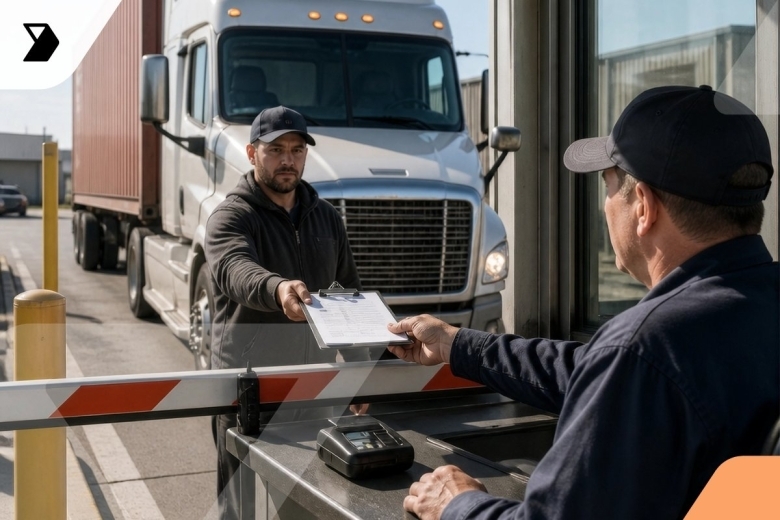
The last place you can stop this is the gate. Verify that the arriving driver, tractor, and documents match the booked carrier of record before you release the load. A mismatch then surfaces while you still control it.

Ready to transform your supply chain?
Increase efficiency and productivity. Say goodbye to delays, handwriting errors, and time-intensive manual data entry.
This guide walks through the four comprehensive steps to catch a double-brokered load at check-in.
Step #1: Understand How Double Brokering Slips Through a Manual Gate
Executive summary: Fraud crews exploit clean-looking paperwork by stealing carrier identities and swapping drivers at the last minute, so facilities must pull dispatch, appointment, and MC or USDOT data before the truck arrives.
Fraud crews use stolen carrier identities, spoof legitimate MC or USDOT numbers, and arrange last-minute carrier swaps after a load is booked. The paperwork reads clean because it was built to do so.
Red Flags to Catch
Three warning signs point to a double-brokered load:
- The driver’s name or credentials do not match the carrier on the dispatch record
- BOL data conflicts with the load plan or shipping manifest
- The driver appears on a banned or flagged list from a prior incident
With these inputs and warning signs in front of you, the first step is confirming identity before the truck reaches the gate.
What You Need on Hand
Every scheduled load requires three data points to be pulled before the driver arrives:
- The booked dispatch record
- The appointment data
- The MC or USDOT number of record for the carrier you hired
That is the baseline that the arriving driver and tractor reconcile against. Without it, the gate has nothing to compare it to, and a swapped carrier passes through as a normal arrival.
Step #2: Pre-Verify Carrier and Driver Identity Before Arrival
Executive summary: Vector FastPass® verifies carrier and driver credentials via SMS, app, or kiosk before the tractor reaches the gate, replacing rushed lane-side decisions with a pre-established baseline match.
The teams that stop double brokering verify before the tractor rolls up, not in the driver lane with a line forming. Pre-check-in verifies carrier and driver credentials against the booked load and sets the baseline against which all subsequent checks are reconciled.

Check-In Modes (SMS, App, Kiosk, or Tablet Before Physical Entry)
Drivers check in through the channel that fits your facility. Vector FastPass® runs pre-check-in via SMS, app, or kiosk, and works across unmanned gates, guard-assisted stations, self-service kiosks, and tablet-based systems.
The driver submits their identity and paperwork before the tractor arrives, giving you time to review the match rather than decide under pressure at the barrier. A driver who arrives without a prior digital check-in completes the same verification at the on-site kiosk, so the match still occurs before the gate opens.
The MC/DOT of the Arriving Carrier
Capture the MC or DOT number at pre-check-in and match it to the carrier you booked. A double broker often arrives under a name that does not tie to the load tender. That mismatch is your clearest early signal because the MC or USDOT number ties back to the carrier you actually hired, not to whoever printed the BOL.
Paperwork can be forged, so verify the driver and tractor against the dispatch record. Compare the driver’s ID and the tractor details against those assigned by the booked carrier.
Vector PreCheck® automates this process by cross-checking carrier authority and safety ratings with the FMCSA database, while verifying driver identity and tractor details against the booked appointment before you release a load.
Once identity is confirmed at pre-check-in, encode that result as a gate rule. A verified match opens the gate. A flagged mismatch places the driver on hold for review.
Step #3: Automate Gate Access So Entry Rules Don’t Depend on Guard Judgment
Executive summary: Rules-based entry through FastPass enforces a single verification standard across manned, unmanned, and kiosk gates, so staffing gaps or subjective guard judgment cannot let a double broker through.
A verified match at check-in only holds if the gate consistently enforces the same rule. When entry depends on a guard’s read of a tractor and a printed sheet, a double broker passes with a rebranded truck or forged paperwork. Rules-based access removes that subjective read.
Rules-Based Entry
Set rules-based entry across unmanned gates, guard-assisted stations, and self-service kiosks. Not every facility runs the same gate. Some sites staff a booth, others rely on unmanned lanes, and many mix kiosks with tablet check-in.
Vector’s FastPass® applies one verification standard across all of them. A driver passes the same identity and credential check whether a guard is present or not, so the rule does not loosen when staffing thins out on the night shift.
Connect Gate Cameras and Hardware to the Check-In Record
Rules mean little if the barrier opens regardless of the result. FastPass® integrates with gate hardware and cameras to enable guardless facilities and autonomous yards. You tie the physical gate to the check-in record, so access opens only when the arriving driver and credentials match the booked carrier on the load.
A mismatch holds the gate and surfaces the exception before the tractor reaches a dock. It also keeps drivers in their trucks during check-in, which cuts foot traffic in the yard.
Step #4: Cross-Reference the Load Plan Against the Shipping Manifest
Executive summary: Vector’s AI imaging scans and cross-references the load plan against the shipping manifest at check-in, flagging commodity or destination mismatches while the trailer is still held at the gate.
A matching driver and tractor still leaves one question open. Do the documents describe the load you booked? A fraudulent carrier can present clean paperwork indicating a different commodity or destination than the load plan calls for. Reconciling the two at check-in catches it while you still hold the trailer.
Load Plan and Shipping Manifest
Vector’s AI imaging scans the paperwork at the point of capture and cross-references the digital files. The system identifies cargo mix discrepancies between the load plan and the shipping manifest before the trailer clears the gate.
If the manifest lists a commodity the load plan does not, or the counts do not line up, the check catches it while the tractor sits at the gate.
Review Mismatches
A discrepancy triggers an exception alert instead of a silent pass-through. Your team reviews the flag and makes a decision before anyone releases the load for dispatch. That timing decides the cost.
Sign off and let the trailer roll, and a cargo mix error becomes a shortage claim, a rejected delivery, or a payment dispute you unwind after the fact. Catch it at check-in, and the fix is a conversation in the driver lane.
Stop Double Brokering Before the Trailer Clears
Double brokering thrives in the gaps between a booked load and the driver who shows up, and those gaps exist right at the gate, where identity, documents, and appointments rarely get verified simultaneously.
Vector closes that gap by tying driver check-in, load documentation, and yard visibility into one connected system, so the person arriving is matched:
- Verified Digital Check-In: Vector FastPass® confirms driver arrival via SMS, app, or kiosk with geofenced check-ins and real-time ETA tracking, so every gate entry is tied to a scheduled appointment.
- Banned Driver Alerts: AI capabilities flag and alert about banned drivers at check-in, stopping unauthorized carriers before they reach the dock.
- Document Authenticity Checks: AI Imaging Agents verify document authenticity and detect BOL manipulation, exposing altered or fraudulent paperwork at the point of handoff.
- Complete Chain of Custody: eBOL creates a digital audit trail with electronic signatures, timestamps, and geocoordinate stamps for every transaction, establishing a chain of custody from the start.
- Automated Gate Control: FastPass® integrates with gate hardware and cameras to enable guardless facilities, so access decisions follow verified data rather than manual judgment calls under pressure.
Explore how Vector can bring verification and visibility together at your gates.
FAQs
What’s the difference between double brokering and legitimate co-brokering?
Legitimate co-brokering happens with the shipper’s knowledge and consent. The booked carrier tells you they are passing the load to a partner, and you approve it. Double brokering hides that hand-off. The carrier you booked rebrokers your freight without telling you, and the driver who arrives is not tied to the carrier on your rate confirmation. The paperwork often reads clean, which is why the mismatch has to be caught at check-in against the booked carrier of record.
Can gate technology alone stop double brokering, or does it still need verification policy and staff training?
Gate technology catches mismatches people miss, but it works best alongside a written verification policy and trained staff. The system flags banned drivers, validates credentials, and cross-references the appointment record. Your team still decides what a flag triggers: hold the trailer, call the carrier, escalate. Automation handles checking at scale, and your policy determines who has the authority to deny entry.
How does an eBOL help prove chain of custody in a double-brokering dispute?
An eBOL builds proof of who handled the load and when. It captures electronic signatures, timestamps, and geocoordinate stamps, creating a complete digital audit trail for every transaction. In a dispute, the record shows the actual driver at pickup and delivery, not just the carrier name on the booking. Vector’s eBOL provides instant access to Proof of Shipment and Proof of Delivery, so you can reconcile the physical hand-off with the booked carrier when a claim arises.
Published on August 10, 2026
Last updated on August 10, 2026
Subscribe to stay updated on Vector and logistics trends
" " indicates required fields

Continue reading

Ready to transform your supply chain?
Increase efficiency and productivity. Say goodbye to delays, handwriting errors, and time-intensive manual data entry.