
The eBOL field report
What we learned digitizing pickup and delivery at 230+ enterprise facilities — across shippers, 3PLs, carriers, and receivers.
Origin
The Consumer Brands Association convened 23 CPG companies and retailers to develop a digital standard for pickup and delivery. Vector was selected as the digitization partner alongside Accenture and Coyote Logistics. Together, the group produced the first industry framework for an electronic bill of lading.
Vector built the technology and has continued the work across hundreds of enterprise facilities. The numbers, processes, and questions in this guide come directly from that field work — not from theory.
“The eBOL fills in a gap that many clients have been asking for. The touchless BOL will result in entry error reduction, increased visibility to OS&Ds, drive lower transportation costs and benefit their green footprint."
Henry Blum
Supply Chain & Operations, Accenture
The vision: what eBOL actually is
At its core, eBOL isn't about technology — it's about protecting your brand, fulfilling customer commitments, and eliminating costly waste. By digitizing
the shipment lifecycle, eBOL enables seamless communication between shippers, carriers, 3PLs, and receivers regardless of how each party operates ensuring accurate, timely, and secure movement of goods from origin to destination.
This guide is grounded in real-world research. We audited over 230 plants, distribution centers, and yards across enterprise shippers and implemented eBOL at more than 100 of them — testing a wide range of configurations to digitize the pickup and delivery process. The numbers, processes, and trade-offs in this document come from that work.
Does eBOL require a standard?
No. The beauty of a modern eBOL solution is that it adapts to each logistics partner's processes, requiring minimal change management yet enabling enhanced collaboration across the supply chain. Any transportation document needed to send a shipment can be digitized, shared, and received in whatever format each party needs.
That matters because the freight network is heterogeneous by definition. A single shipper might work with carriers running modern TMS platforms, regional fleets with basic ELDs, and owner-operators with flip phones. A standard that requires everyone to upgrade simultaneously will not be adopted. A platform that meets each partner where they are will be.
Benefits across the supply chain
The four parties involved in a typical shipment — shippers, 3PLs, carriers, and receivers — each gain something concrete from digitizing the bill of lading. No partner is asked to absorb cost so another can benefit, which is why adoption holds.
The universal benefits
- Safer. Drivers stay in the cab; fewer trips between the truck and the welcome center reduces injury and weather exposure.
- Faster. Drivers get in and out, preserving HOS and meeting delivery deadlines.
- Clearer. Visibility and collaboration improve across shippers, carriers, 3PLs, and receivers.
- Error-proof. Fewer errors, less rework, fraud caught earlier, discrepancies surfaced before they become disputes.
What each party gets

Shippers
Visibility and loss prevention
Real-time pickup and delivery tracking across all logistics partners. Verified proof of shipment and delivery on every load. Double-brokering and theft caught at the gate, not after the loss. Paperwork eliminated for the welcome center and warehouse.

3PLs & brokers
Control across your network
Standardized digital records across every carrier and facility—even those you don't own or directly manage. Faster billing and dispute resolution with full documentation. Fewer chargebacks from missing or illegible paper BOLs. A single source of truth shared with shippers and receivers.

Carriers
Drivers in and out faster
Less dwell time, more drive time, more HOS preserved. Drivers stay in the cab — safer and faster. Back office invoices customers faster, improving cash flow. Every document digitized, saved, and searchable.

Receivers
Know what's coming and when
Real-time notifications when loads are picked up, with live ETA. Better dock scheduling and labor planning. Advance visibility into freight contents before the trailer arrives. Paperless intake at the gate and dock.
Why eBOL was difficult to implement until now
The short answer is interoperability. There is a wide range of technology and various levels of digital maturity across logistics partners, especially carriers. Drivers do not want to download or learn another app. And current regulations still prohibit the digitization of hazmat documents, meaning any eBOL solution has to run alongside paper for certain freight types.
The way through is not to force standardization but to make the platform agnostic — read paper, read PDFs, integrate with TMS and WMS where they exist, and fall back to SMS where they don't. That is the change in the last few years that has made eBOL viable at scale.
Want to see how this would run in your facility?
Pre-arrival
The shipper schedules the shipment and selects a carrier. Freight details are confirmed: weight, dimensions, destination, service level. A bill of lading is generated, serving as a legal contract and receipt for the cargo. Depending on the facility, the process may require additional information like the driver's license, DOT number, or trailer number.
The critical tracking event in this phase is the moment the driver pulls up to the facility's security checkpoint. Everything before that is preparation; everything after is execution.
100%
Of companies have a guard check-in process at some facilities
61%
Have an unmanned check-in process at some facilities
45%
Needed a way to verify what's in the trailer before it enters
28%
Want to move some facilities to unmanned check-in
Key data elements at pre-arrival
- Picture ID
- Carrier ID (SCAC)
- Truck DOT number
- Appointment time
- BOL number
- Driver cell phone
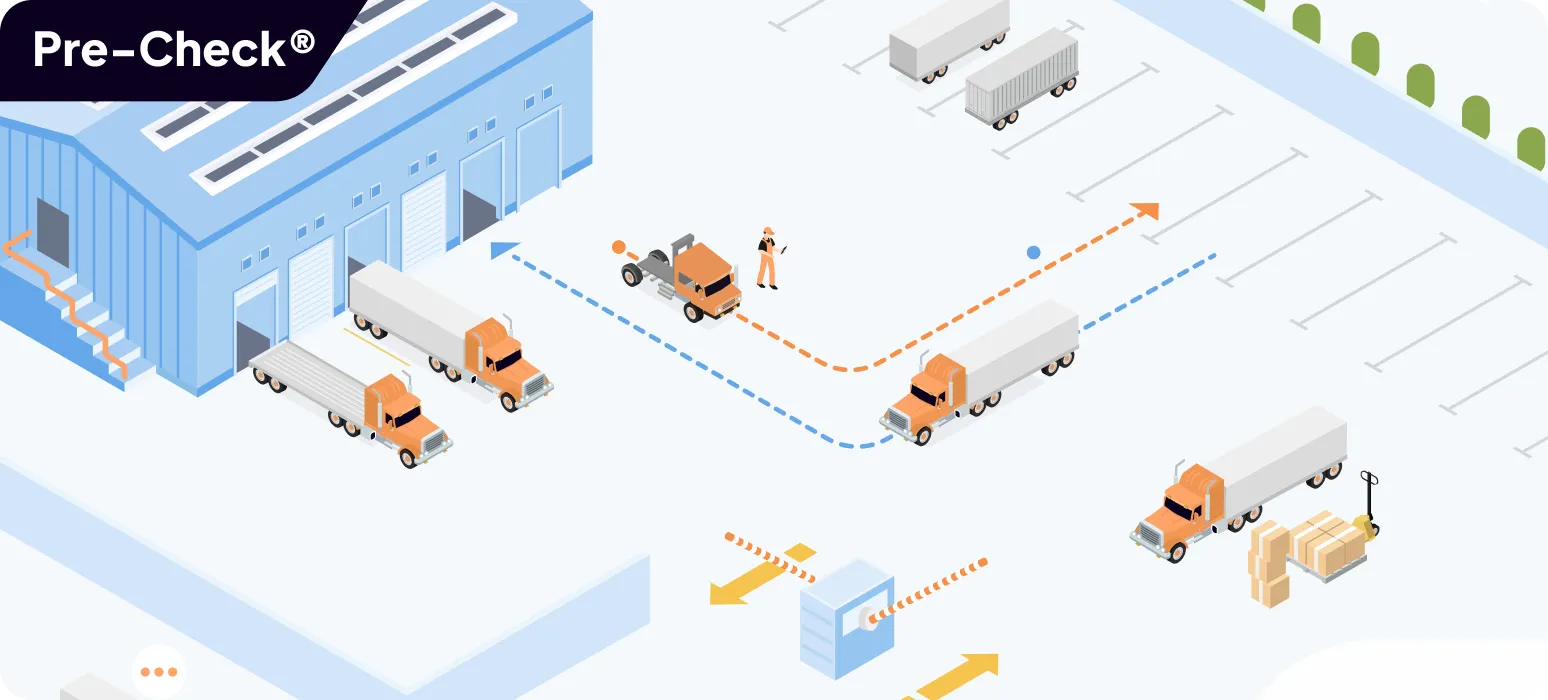
PreCheck® — checking in 24 hours before arrival
Drivers can PreCheck® within 24 hours of arrival. Carriers integrate Vector into the ELD and telematics workflow, and driver and shipment information is matched to the customer appointment number. If a driver doesn't have ELD or telematics connected, the shipper or carrier dispatch assigns the driver cell phone to the appointment number, and the driver receives an SMS alert before arrival. Drivers using flip phones can still participate through the carrier's ELD workflow or wait until arrival to check in with the guard.
96%
Of check-ins are provided to drivers via SMS
85%
Of dedicated drivers
use the native app or telematics workflow
10%
Of one-way drivers use PreCheck®
Common questions
Carriers integrate Vector into the ELD and telematics workflow. Driver and shipment information is matched to the customer appointment number, and on arrival the driver gets an accelerated check-in at the guard shack.
The facility provides WiFi for its carriers. This is the standard rural solution and is part of every rollout plan.
Check-in is managed by the welcome center or warehouse personnel. Vector supports guard-initiated, driver-initiated, and kiosk-initiated check-in interchangeably.
At arrival
After the driver checks in at the gate, the next critical tracking event is checking in at the welcome center to receive a dock door assignment. This is where dwell time accumulates fastest in most facilities — and where digitization has the largest immediate impact.
100%
Have a welcome clerk assignment process at some facilities
64%
Expressed interest in reducing wait time to assign drivers to doors
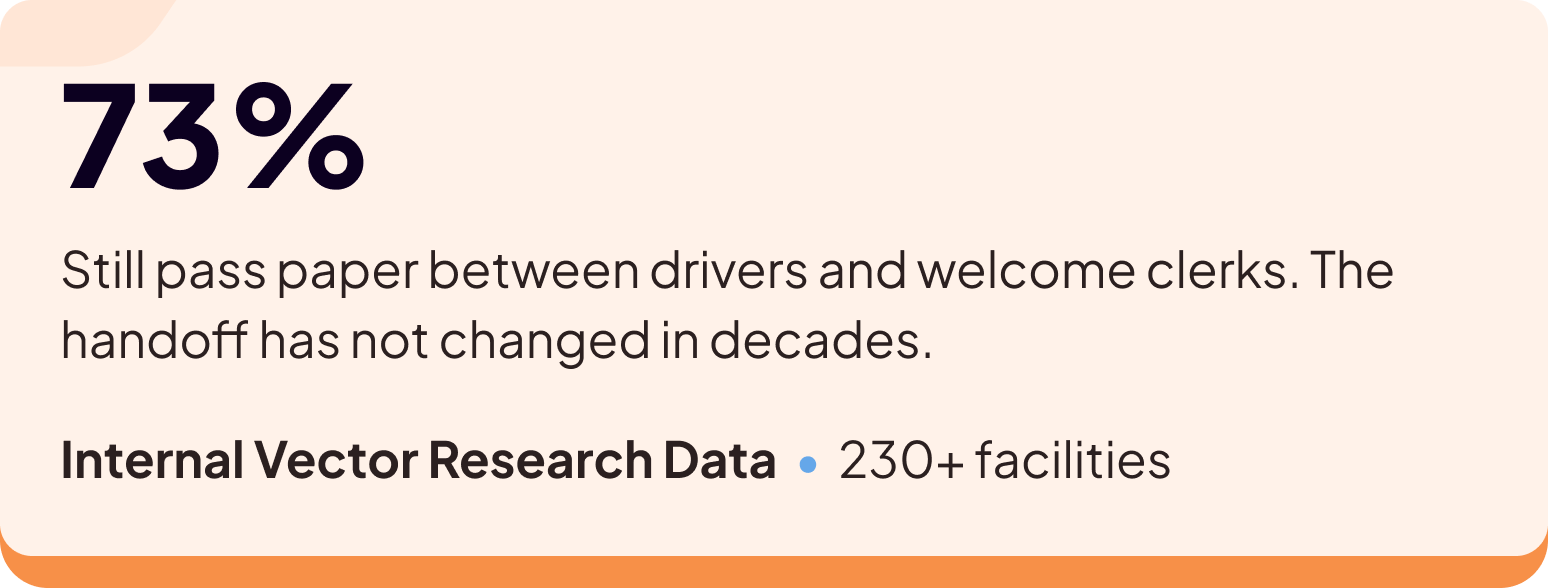
Key data elements at arrival
- Pick-up type
- Dock door
- Yard location
- Truck number
- Trailer number
- SCAC
- Shipment number
How the welcome center transforms
The driver remains in the truck; communication with the welcome clerk happens through the app or via SMS. If there is no guard shack, the welcome clerk handles both check-in and door assignment digitally. If there is no welcome clerk, warehouse personnel handle door assignment directly. The platform tracks the conversation, so shift changes don't lose context.
Common questions
The welcome center or warehouse communicates directly with the driver through the app or via SMS once they've checked in.
The platform tracks communication between drivers and personnel so new staff have immediate context when they take over.
The solution ultimately replaces the tubes.
In the Yard
The driver is assigned a dock door. Items are loaded, scanned, and temperature (if applicable) is recorded via photos or input. Pallet license plates and packing list barcodes are captured in-app for traceability. Once loading is complete, the warehouse shares the pick sheet and generates the eBOL. If the trailer is not preloaded, a seal is assigned, attached, photographed, and matched to the eBOL.
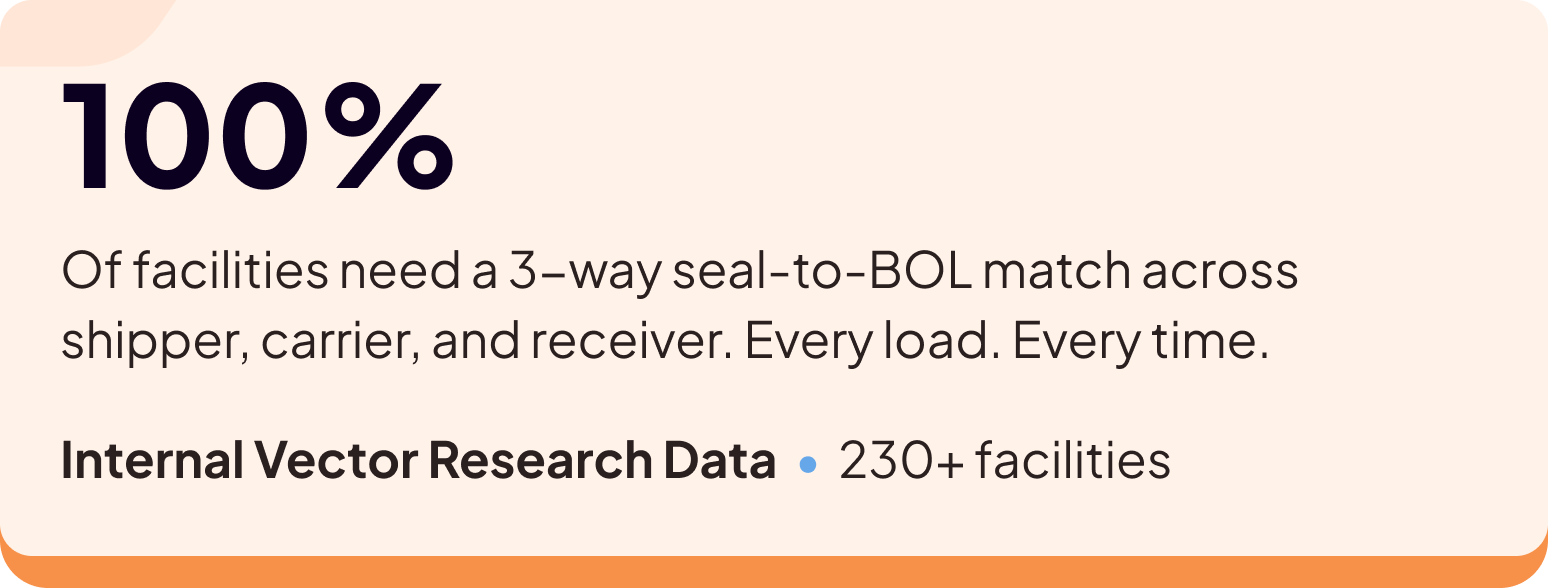
A further 42% of facilities also need to verify trailer temperature at pickup and drop-off — a hard requirement for food, beverage, and pharma freight.
Key data elements in the yard
- Shipment number
- Shipment status
- Shipment date
- Shipment trailer number
- BOL number
- PO number
- Pick sheet number
Common questions
Yes — pallet license plate information is captured and shared.
The platform captures barcode information from the packing list. The receiver scans the barcodes from pallets using the app to verify they match.
Take a photo of the control panel or enter the information through the app — either way it's automatically timestamped.
The platform captures temperature monitoring photos at pickup and unload for bulk or liquid transport, and documents tank washes.
Checkout
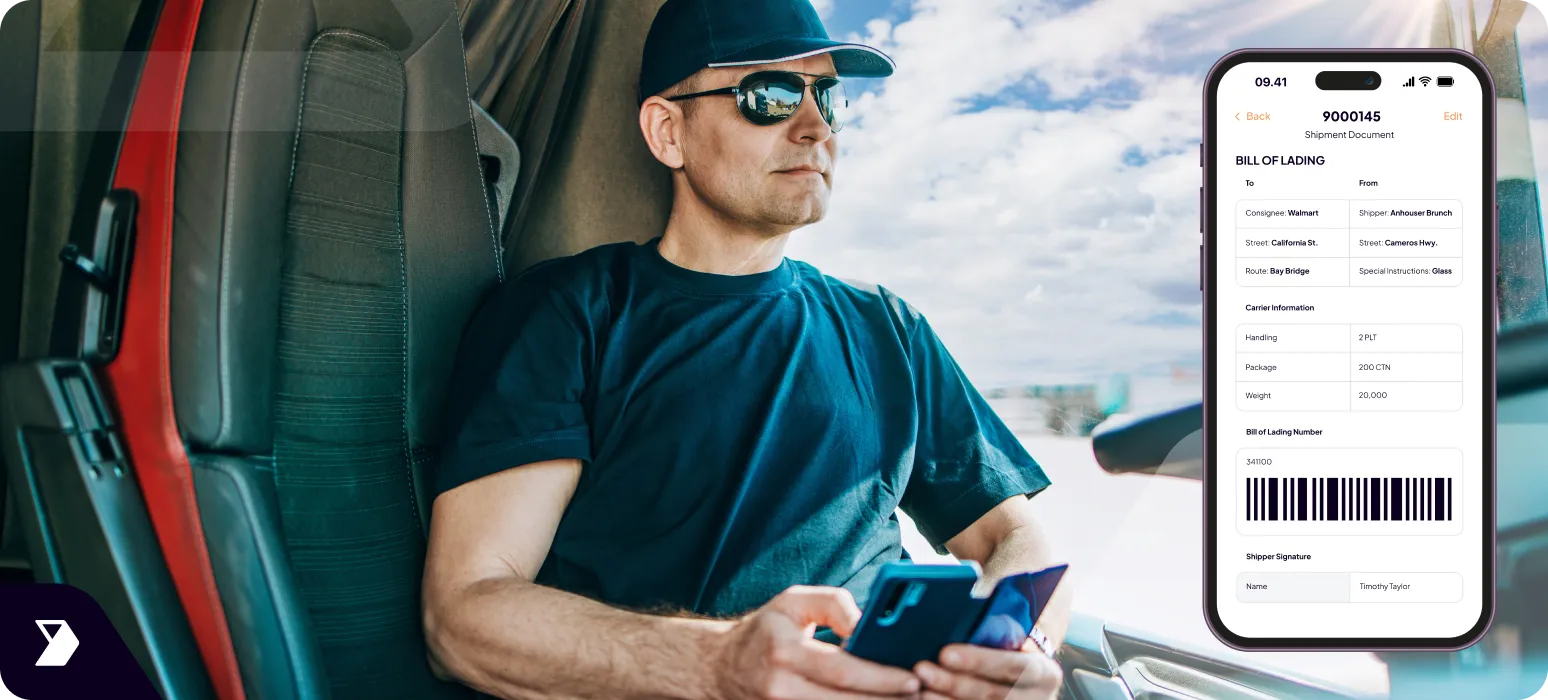
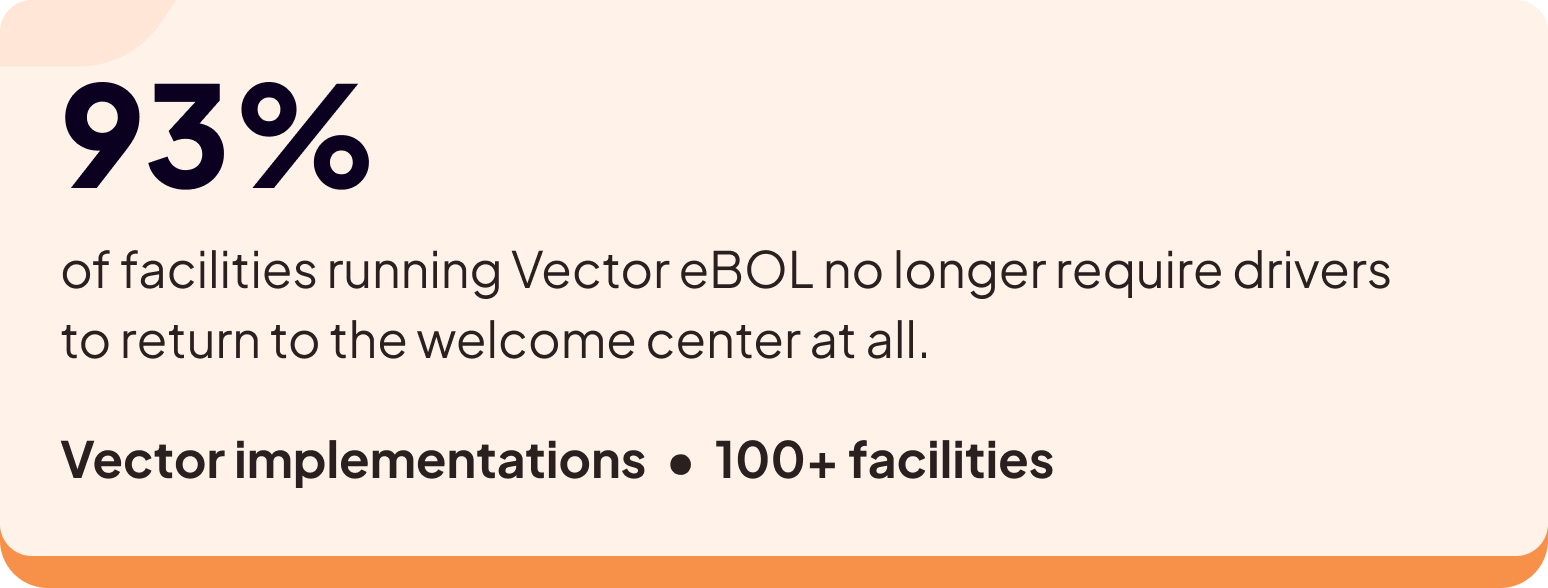
The eBOL is sent digitally to the driver, eliminating the need to return to the welcome center. At 33 percent of facilities running Vector, drivers do not return at all — documents are printed and seals provided at the warehouse. The carrier maintains possession and responsibility for the cargo from this point forward.
Key data elements at checkout
- Seal number
- Outbound seal photo
- Outbound seal photo number
- Outbound seal verification
Three ways to manage the eBOL handoff

OPTION A
Driver returns to welcome center for the seal
- Warehouse sends pick sheet to welcome center
- Welcome clerk sends eBOL to driver
- Driver walks to welcome center for seal
- Driver returns to truck, seals trailer
Closest to status quo

OPTION B
Driver stays in truck, warehouse seals the trailer
- Warehouse sends pick sheet to welcome center
- Welcome clerk sends eBOL to driver
- Warehouse seals the trailer
- Driver departs from the dock
Hybrid

OPTION C
Warehouse handles everything, Steps 3 + 4 merge
- Warehouse originates eBOL directly
- Warehouse seals the trailer
- eBOL pushed to driver in-cab
- Driver departs from the dock
Most efficient · Driver never leaves the truck
Common questions
Yes — though for every SKU it can take significant time.
Whether the BOL is paper or PDF, the app extracts the data and populates it in the correct fields. No code, no EDI, no API integration required.
A notification is sent when loading starts. When loading completes, the BOL is shared with the driver via in-app notification, SMS, or email.
If you've read this far, you should probably see it in action.
In transit
The freight moves through the transportation network and is linked to tracking updates. Transit times to each destination are monitored, and ETA updates account for traffic and weather. If a weigh station is encountered, the eBOL can be shown as proof of delivery and product. Visibility systems track tractors every 30 minutes to keep ETAs accurate.
Key data elements in transit
- Departure time
- Departure location
- Arrival location(s)
- Stop times
Common questions
Yes, through tractor ELDs and visibility software that incorporates traffic, weather, and historical lane data.
Yes. The receiver can receive notification and reschedule the arrival appointment if necessary.
It depends on the solution. Basic ELDs track only the tractor. Better solutions add lane history, weather, time of day, and traffic to verify ETAs algorithmically.
Delivery
The driver performs a pre-arrival check-in if required, arrives at the facility, is checked into the yard via shipment or appointment number, reports to a dock door, is unloaded, and departs. Geofences identify when a load is nearing the facility and can trigger advance notification. Appointments include eBOL information and a method to download and use the eBOL.
Key data elements at delivery
- Departure time
- Departure location
- Arrival location(s)
- Stop times
- Pre-check-in time
- Geofences
- Appointment time
Common questions
Yes — via SMS or app. For operations without SMS capability, dock door lights can signal when loading or unloading is complete.
Yes. The appointment creator confirms the eBOL number, either at appointment creation or after eBOL creation and arrival at destination.
Yes — this gives the receiver advance notice that the load will arrive soon.
Billing
The signed eBOL is immediately available to back-office systems for all logistics partners. Invoices generate from the BOL and supporting documentation. OS&D claims are handled digitally with photos, notes, and timestamps. All documents are archived and searchable for compliance, audits, and disputes.
70%
Have a mix of warehouse, guards, or drivers attaching seals
36%
Want only warehouse personnel handling the seal
18%
Require CTPAT compliance
Key data elements at billing
- Seal verification
- Scale-out
- Tarping photos
- Date
- Time out
Common questions
Yes. Receivers are notified automatically as transactions happen or as updates are made to the eBOL — all with timestamps.
In addition to the standard ASN, you can send receivers contextual information about the load: BOL image, trailer seal photograph, and ETA.
The driver documents the break and the reason — for example, a roadside inspection. The record stays attached to the shipment.
An alert goes out to all relevant parties via email and text. The discrepancy is logged with the shipment and can always be referenced later.
Anyone can report an OS&D through the app — take a photo and use voice-to-text to annotate the issue.
Digitizing BOLs and embracing a contactless pickup and delivery process supports CTPAT. The system makes auditing and verification easier, with eSignature timestamps and contextual photos.
See it run on one of your lanes
If this resonates with what you're working on, the fastest next step is a 30-minute walkthrough. We'll map your current pickup and delivery process, show where eBOL fits, and share what the audit data says about facilities like yours.