
Vector vs. Oracle Warehouse Management Cloud: A Standalone Yard Platform or a WMS Module?
9 min read
Vector and Oracle Warehouse Management Cloud both operate in the distribution center, but in different parts. Oracle WMS runs operations inside the building — receiving, putaway, picking, packing, and shipping — as a tier-1 warehouse management system in Oracle Cloud.
Vector runs the edges of the building and the yard — the bill of lading, the gate, the yard and dock, the carriers, and billing.
They overlap in one place: the yard, the gate, and the dock. There, Oracle’s yard management module and Vector’s standalone yard platform do comparable work. Beyond it, they diverge. Oracle runs the warehouse interior, which Vector doesn’t touch. Vector isn’t a WMS.

Ready to transform your supply chain?
Increase efficiency and productivity. Say goodbye to delays, handwriting errors, and time-intensive manual data entry.
By comparing them directly at the yard, gate, and dock, this article clarifies the scope of each system.
What Each Platform Is Built to Do
These two products have moderate overlap, with a few key differences. Oracle manages the warehouse and offers its own module for yard operations. In contrast, Vector specializes exclusively in the yard, the gate, and the surrounding documentation.
Here’s each in brief.
Vector: Facility Execution, Built From the Bill of Lading
Vector started with the bill of lading and built outward from it. Its platform runs the facility natively: eBOL document digitization, driver check-in at the gate through Driver PreCheck®, a yard management system that assigns and tracks yard moves, and dock appointment scheduling.
On the carrier side, it captures documents, reads them with OCR and AI, and runs rendition billing. A carrier network and instant proof of delivery connect the gate and the paperwork to billing.
Vector doesn’t manage what happens inside the warehouse. It manages the yard, gate, and documents, and connects to a WMS, TMS, or ERP via API, EDI, and email.
Oracle Warehouse Management Cloud: A Tier-1 WMS With a Yard Module
Oracle Warehouse Management Cloud runs inside the warehouse. It handles receiving, putaway, picking, packing, and shipping, with wave management, inventory tracking down to lot and serial, labor optimization, cross-docking, value-added services like labeling and kitting, and returns.
It connects to material-handling automation — robots, conveyors, sortation, pick-to-light — and recently added AI agents that review wave execution and flag at-risk or expiring inventory. It’s part of Oracle Fusion Cloud Logistics, alongside Oracle’s transportation management, global trade, and order management, and it runs inside Oracle’s wider SCM and ERP cloud.
Gartner has named it a Leader in warehouse management for 11 straight years, most recently in the 2026 Magic Quadrant. For this comparison, the part that matters is Oracle’s yard management module: gate check-in and check-out, dock appointment scheduling, a yard map, and trailer tracking.
Oracle runs all of it as a capability within the WMS, not as a standalone yard product, and the richer appointment and telematics components rely on Oracle Transportation Management and IoT Fleet Monitoring. To ensure an accurate, apples-to-apples evaluation, this analysis compares Oracle’s yard module directly with Vector.
Warehouse vs. Facility: Where the Two Operate
It helps to map where each product actually works before comparing features.
Oracle’s footprint is the warehouse and the attached yard. Inside the building, it runs the full warehouse management job — receiving through shipping, inventory, labor, and automation.
Outside, it includes basic yard management capabilities: gate check-in, dock appointment scheduling, a yard map, and trailer tracking, all of which are run from the same WMS. So Oracle treats the building interior and the surrounding yard as a single system, native to Oracle’s inventory and ERP.
Vector doesn’t handle inside-the-warehouse work like picking, packing, or inventory. Instead, it serves as the operational execution layer for everything outside the building. Vector connects shippers, carriers, and receivers through a shared network.
That network manages physical yard and gate operations alongside the digital transfer of custody, connecting dock scheduling, bills of lading, proof of delivery, and billing.
So the two overlap squarely in one place: the yard and the dock. Everywhere else, they diverge. Oracle does the warehouse interior, which Vector doesn’t touch. Vector does documents, billing, and carriers, which Oracle’s WMS largely leaves to other systems.
The rest of this comparison covers the yard and dock, where both products compete directly. It also looks at documents and carriers, areas where Vector adds valuable features that Oracle WMS does not offer.
Yard, Gate, and Dock Execution
This is where the two products genuinely overlap, and both offer strong capabilities.
Oracle’s yard management covers the core yard functions well. A guard checks trailers in and out at the gate, capturing driver and reference details.
Dock appointments are scheduled on a workbench where carriers and shippers can collaborate, though that scheduling workbench sits in Oracle Transportation Management rather than the yard module itself. The system tracks trailer location, dwell, and detention across the yard, with a yard map and yard-jockey tasks on a mobile device.
It can use RFID for location, and, in an advanced setup, it integrates with Oracle’s IoT Fleet Monitoring, so a truck crossing a geo-fence is automatically assigned a dock door or sent to wait. Because it’s part of the WMS, a trailer’s yard status and the inventory inside it live in one system.
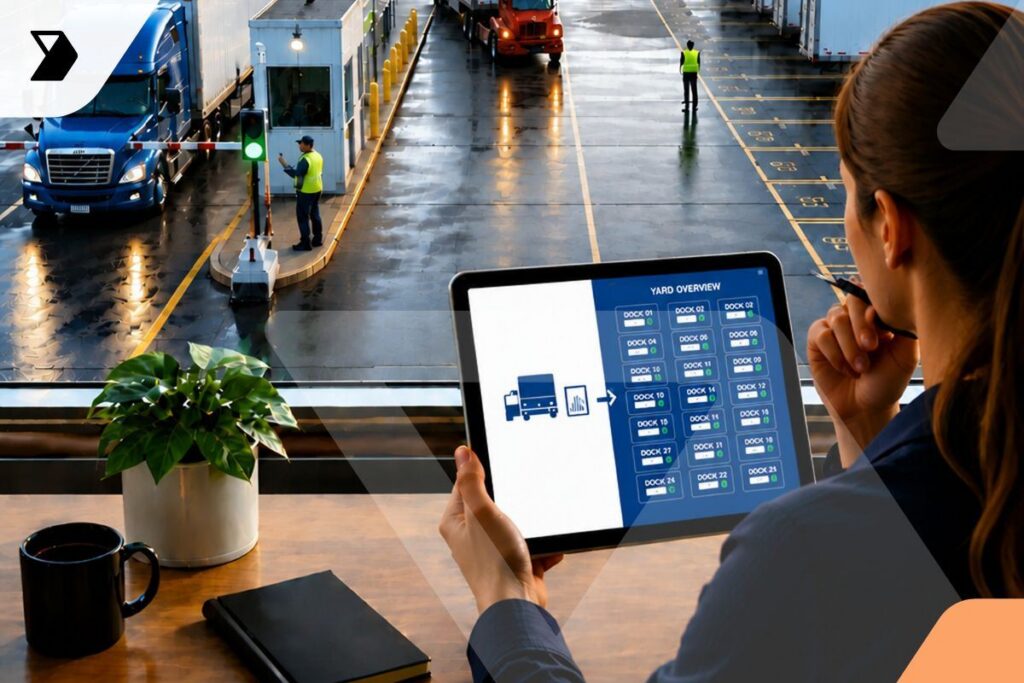
Vector’s yard covers the same core yard functions — gate check-in, dock appointments, yard map, jockey tasking, trailer tracking, and detention monitoring — but the gate and the tracking work differently.
Check-in runs through Driver PreCheck®: the driver gets a text before arrival, with no app and automatic language translation, instead of a guard keying in details. The yard is tracked through gate and move events rather than requiring RFID hardware.
Vector’s eBOL runs an AI-powered seal match to catch freight fraud, where Oracle captures a seal code as an optional field.
On the core yard and dock functions, the two are close. The differences are at the edges: Oracle’s yard is native to the warehouse and can use RFID and IoT; Vector’s gate is more driver-self-service, tracks without RFID, and adds a seal match to catch fraud.
Documents and Billing: BOL to POD
Both products produce documents, but in different ways and at different points. Oracle generates them from order data. In contrast, Vector captures them at the gate and integrates them directly from external shipping systems.
Oracle creates shipping paperwork as part of the warehouse flow. Upon ship confirmation, it generates the bill of lading, packing slip, and commercial invoice from the order and shipment data, as printed documents or PDFs.
The BOL includes signature lines so it can double as a delivery receipt. For third-party operators, Oracle also bills clients for warehouse services — receiving, storage, picking, shipping — by activity, producing an itemized 3PL invoice.
At yard check-in, it can capture reference documents against a trailer. So Oracle handles documents as outputs of the warehouse process and bills for the work done in it.
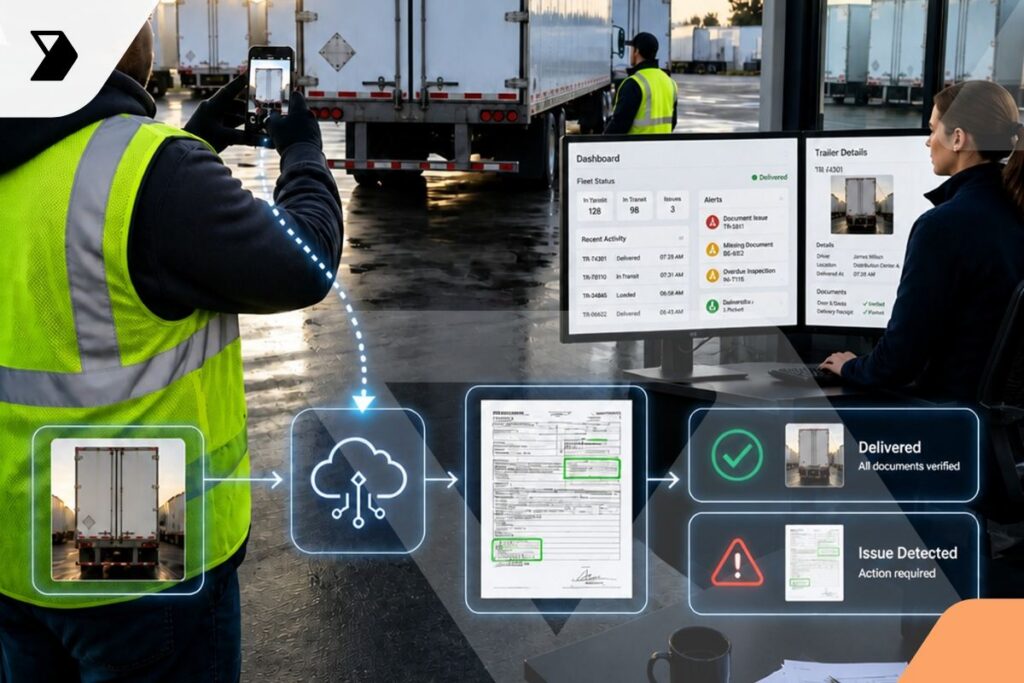
Vector approaches documents from the other end, capturing them at the handoff point. Its eBOL turns a paper bill of lading into a digital document in seconds, with image-quality screening and AI photo enhancement.
Once signed, the BOL becomes a Proof of Shipment, and proof of delivery is available within minutes, each with an electronic signature and a timestamped, geo-stamped audit trail.
To prevent fraud, an imaging check automatically flags anomalies, such as edited case counts. Because billing can start the moment delivery is confirmed, paperwork never holds up the invoice.
This workflow does double duty. It automatically packages the documents needed for immediate rendition billing, and it logs the precise data required to meet CARB, TRU, FSMA 204, and WAIRE compliance standards.
One key difference is between generating and capturing, and what billing keys off.
Oracle prints the BOL for the order and bills for warehouse services; Vector captures the signed BOL at the gate, converts it to a POD, and bills for the delivery itself.
An operation whose pain is slow PODs and a billing cycle that drags after delivery would find that in Vector, not in the WMS.
Carrier and Driver Connectivity
The two products handle carriers and drivers differently, and Oracle splits the job across multiple products.
In Oracle WMS, carriers primarily enter via dock scheduling: carriers and shippers collaborate on appointments through the scheduling workbench. The heavier carrier work — selecting and tendering carriers, auditing and settling freight — lives in Oracle Transportation Management, a separate product in the Fusion Cloud Logistics suite.
At the gate, a guard registers the driver and trailer, or, in an advanced setup, an IoT geo-fence automatically checks the truck in. It’s a capable set of carrier tools for a company running the Oracle suite. Still, it’s carrier management across products rather than a built-in carrier network, and it doesn’t verify carrier identity for fraud.
Vector brings the carrier network directly into the product. Its Connect+ Carrier Network of around 200 carriers is wired into the same workflow that runs eBOL, check-in, and billing, so carriers are part of the document and gate flow.
At onboarding, Vector verifies the carrier’s identity and adds fraud and double-brokering checks at the point of entry. Drivers check in through Driver PreCheck® by text message before arrival, in their own language, with no app and no guard keying in their details.
The contrast comes down to a built-in, verified network versus carrier management connected to Oracle’s WMS or TMS. If you want carriers and drivers to arrive pre-connected, verified, and tied directly to the paperwork, that’s where Vector shines.
If your carriers are already collaborating within an existing Oracle system, Oracle covers those needs within its own suite.
Ecosystem and Deployment: Oracle Fusion Cloud vs. Standalone
Like other enterprise platforms, Oracle WMS is strongest within its own cloud.
Running alongside Oracle Inventory, Transportation Management, and ERP on Oracle Fusion Cloud, the warehouse and the yard share a single data model with the rest of the business — inventory, orders, transport, and finance in the same system, under one vendor.
For a company already standardized on Oracle, that nativeness is the main reason to choose it; the WMS is already integrated. Oracle also offers the WMS as a cloud product that can be deployed more quickly than legacy systems, enabling 3PLs to onboard new clients more quickly.
The trade-offs show up off the Oracle path: reviewers point to high total cost of ownership, a steep learning curve, and costly, higher-risk integration for companies that don’t run Oracle. Getting the most from it generally means committing to the Oracle stack and an enterprise implementation.
Vector is built to stay independent and deploy fast. It connects to WMS, TMS, and ERP systems — including Oracle — via API, EDI, and email. Hence, it runs on top of whatever a facility already has rather than requiring a particular stack.
Rollout is quick, and change management is light: one grocery customer was live on Vector’s yard management in about 30 days. A facility doesn’t re-platform to adopt Vector; it adds Vector to what’s there.
So the deployment question mirrors the scope one. If the operation is built on Oracle and wants the warehouse and yard native to that cloud, Oracle WMS is made for it, enterprise rollout and all.
If an operation needs to rapidly modernize its yard, gate, and document workflows across existing platforms, Oracle or otherwise, Vector acts as a powerful orchestration layer. It integrates directly with Oracle WMS, connecting internal warehouse operations with the broader carrier network and automating the digital chain of custody.
What Customers Say
Vector
“The drivers love [the Vector app and Trimble display] for ease of use and the increased space in the cab from less equipment. The app also enables enhanced functionality like barcode scanning and pre-filled data fields, which makes the task of scanning documents easier and requires fewer manual steps for drivers.”
— Alex Kjelland, operations coordinator, asset management, for Magnum
“It’s the ins and outs of our transportation office and the communication with the clerks that has been so much more streamlined via the text messaging application.”
— Jonathan, Sprouts Markets
“Today I stood out at the welcome center here at Olathe Production Center and saw a Marten driver drop & hook in like, 5 minutes. It felt like a full-circle moment seeing the vision coming to life.”
— Matt Bromley, Business Process Lead: Demand, Supply and Transportation, Heartland Bottling
Oracle Warehouse Management Cloud
“It is one of the best cloud-based WMS out in the market, offering to automate your supply chain fulfilment processes end-to-end and with good Oracle cloud native integrations available out of the box.”
— Gartner Peer Insights review (Oracle Fusion Cloud Warehouse Management)
“Do not like that not is integrate with the ERP and do not have all the functionalities that an others WMS, as Slotting and yard managment.”
— Gartner Peer Insights review (Oracle Fusion Cloud Warehouse Management)
Side-by-Side Comparison
| Capability | Oracle WMS Cloud | Vector |
| Warehouse management (receive, pick/pack/ship, inventory, labor) | Yes — tier-1 WMS, core strength | Not offered |
| Warehouse automation (robots, conveyors, sortation) | Yes — MHE/WCS integration | Not offered |
| Yard management | Yes — gate check-in, yard map, jockey tasks, trailer tracking | Native YMS: gate check-in, yard map, jockey tasking, trailer tracking |
| Gate check-in | Guard-registered; optional RFID/IoT geo-fence auto-check-in | Vector PreCheck® (SMS, no app) |
| Dock & appointment scheduling | Yes — collaborative dock workbench | Native, rule-based, carrier self-serve |
| Yard location method | RFID or manual; IoT geo-fence | Gate and move events plus a map; no RFID |
| Seal / freight-fraud | Optional seal-code capture | eBOL and AI-powered seal match |
| eBOL (electronic bill of lading) | Generates BOL from order data at ship confirm | Yes — gate capture, AI imaging, signed eBOL |
| Proof of delivery / document-to-billing | BOL has signature lines; no capture/ePOD workflow | Yes — instant POS/POD, billing from delivery |
| Billing | 3PL billing for warehouse services, by activity | Rendition billing: billing from delivery |
| Carrier connectivity | Dock-scheduling collaboration; carrier management via Oracle TMS | ~200-carrier Connect+ network, workflow-integrated |
| Carrier identity verification | Not offered | Yes — verified at onboarding |
| Driver experience | Guard registration or IoT geo-fence | Driver PreCheck® — SMS, no app, multilingual |
| AI | AI agents for wave and inventory | Applied AI (imaging, anomaly, gate); co-pilot |
| Scope | WMS plus a yard module, inside Oracle cloud | Facility: yard, gate, documents, carriers, billing |
| ERP requirement | Strongest on Oracle Fusion Cloud; integrates others | ERP-agnostic; API, EDI, email; Oracle included |
| Deployment | Cloud WMS; enterprise rollout for full value | Standalone, fast rollout, light change management |
The Bottom Line
Vector and Oracle Warehouse Management Cloud overlap less than the category suggests. Oracle is a tier-1 WMS that runs the inside of the warehouse — from receiving through shipping, inventory, labor and automation — with a capable yard module attached and the full weight of Oracle’s cloud behind it.
Vector runs the yard, the gate, and the documents, not the warehouse interior. Its center is the bill of lading: gate-capture eBOL, instant proof of delivery, and billing from the delivery event, joined to a native yard and gate, a carrier network, and carrier identity verification.
Published on July 14, 2026
Last updated on July 14, 2026
Subscribe to stay updated on Vector and logistics trends
" " indicates required fields

Continue reading


Ready to transform your supply chain?
Increase efficiency and productivity. Say goodbye to delays, handwriting errors, and time-intensive manual data entry.