
How LTL Freight Works, When to Use It, and How to Manage Its Challenges
8 min read

Key takeaways
- LTL freight covers shipments too small to fill an entire trailer. These shipments move through a shared hub-and-spoke network, passing through multiple terminals before reaching their destination.
- Each terminal transfer in an LTL shipment creates documentation risk that can corrupt BOL data, delay invoice processing by 30 or more days, and give carriers grounds to question your facilities as preferred partners.
- Detention, accessorial, and reclassification charges are among the most controllable costs in LTL shipping, but only when your team has the necessary timestamped proof of delivery and real-time yard visibility needed to dispute inaccurate charges.
- Facility platforms that connect eBOL capture, digital check-in, and yard trailer tracking compress LTL billing cycles from weeks to same-day, while building the reliability carriers look for when designating Shippers of Choice.
A missing POD turns your routine LTL shipment into a three-week invoice standoff. Your carrier can’t prove delivery. You can’t process payment. The relationship deteriorates while both sides point fingers over paperwork that should have taken minutes to capture.
Each transfer point in LTL freight transport creates an opportunity for documentation to disappear or arrive incomplete. These gaps accumulate across frequent shipments, leaving invoices held for 30+ days and carriers questioning whether your facilities are worth the hassle.
Understanding how LTL operates at your dock doors is the prerequisite for controlling detention costs and earning Shipper of Choice status.
Ready to transform your supply chain?
Increase efficiency and productivity. Say goodbye to delays, handwriting errors, and time-intensive manual data entry.
What Is LTL (Less-Than-Truckload) Freight?
Executive summary: LTL freight uses shared trailer space consolidated at carrier terminals. Four operational factors determine when LTL is the right mode choice over FTL or parcel: cost structure, transit predictability, handling exposure, and departure timing control.
LTL freight refers to shipments that don’t fill an entire trailer — typically measured in hundredweight or pallet count rather than full truckloads. You share trailer space with other shippers’ freight, which carriers consolidate at terminals before moving to final destinations.
This shared-capacity model reduces your per-shipment transportation costs but introduces additional handling points and transit time compared to dedicated truckload service.
LTL vs. FTL Freight
When you’re choosing between LTL and FTL for a specific lane, four operational factors drive the decision more than abstract cost comparisons.
- Cost structure shifts the calculation beyond rate per mile. LTL charges by hundredweight with potential reclassification penalties. FTL gives you a flat rate regardless of actual weight, but you’re paying for the entire trailer whether you fill it or not.
- Transit predictability favors FTL decisively. Your freight moves directly from pickup to delivery without terminal stops. LTL shipments may move through one or more terminals where freight is unloaded, sorted, and reloaded, which can result in longer transit times.
- Handling exposure multiplies with each LTL terminal transfer. Your freight gets touched by different crews at each consolidation point. FTL keeps your freight sealed from origin to destination.
- Departure timing gives you direct control in FTL arrangements. You coordinate pickup windows directly with the carrier. LTL departure depends on route optimization across multiple shippers, reducing your influence over when freight actually moves.
LTL vs. Parcel Carrier Operations
LTL carriers handle multi-pallet shipments requiring BOLs and dock-level delivery. Parcel carriers process individual packages through automated sortation hubs.
Your TMS manages LTL bookings and freight class calculations. Parcel shipments typically integrate through shipping software or WMS APIs.
LTL requires dock appointments and driver check-in processes. Parcel operates on drop-and-go pickup schedules with minimal facility interaction.
How LTL Freight Moves Through the Supply Chain
Executive summary: LTL freight moves through a hub-and-spoke network with multiple handoff points from booking to delivery. Multi-facility operations amplify the coordination challenges when delayed inbound shipments cascade into downstream disruptions.
LTL freight moves through a hub-and-spoke network that creates multiple handoff points between your facility and final delivery.
Each terminal transfer introduces potential gaps in both physical tracking and digital documentation that compound across the shipment lifecycle.
LTL Shipping
LTL shipments move through multiple handoff points from booking to delivery: BOL creation, pickup, terminal consolidation, linehaul transport, deconsolidation, and final delivery.
Each handoff creates documentation risk. Your BOL data can become corrupted when transferred between carrier systems, leaving you unable to track shipment status or defend billing disputes.
At consolidation terminals, shipments often sit without status updates for hours or days. When deconsolidation occurs at the destination terminal, your freight may lack accurate delivery windows or special handling instructions if data was lost upstream.
Intermodal Transportation in LTL
Many LTL carriers incorporate rail segments into their networks to move freight between major terminals across longer distances. Your shipment may transfer from truck to rail and back to truck during transit, with each handoff adding potential delays.
Rail schedules operate on fixed timetables that don’t align with trucking flexibility, creating situations where trailers sit idle for hours, waiting for the next available rail departure.
Multi-Facility Distribution
LTL shipments flow through your facilities in three primary patterns
- Inbound supplier freight feeding production lines
- Outbound customer replenishment maintaining inventory levels
- Cross-dock consolidation, where freight arrives from suppliers and departs to customers within the same operational window.
When LTL moves across multiple facilities simultaneously, coordination challenges increase exponentially.
A delayed inbound LTL shipment at your main distribution center creates ripple effects at downstream facilities expecting cross-dock transfers. Your team must track freight status across facilities, manage dock capacity when multiple LTL carriers arrive unannounced, and coordinate transfer schedules that depend on uncertain arrival times.
Without real-time visibility into LTL movements, facilities default to buffer inventory and extended dock windows—both of which inflate operational costs and reduce throughput efficiency.
When Should You Use LTL Freight?
Executive summary: LTL is the right mode when shipments fall between parcel limits and full truckload capacity, and when your freight profile includes consistent lanes, commodities tolerant of additional handling, and loads that don’t require exclusive trailer control.
LTL becomes your logical choice when shipments fall between parcel limits and full truckload capacity — typically several hundred to several thousand pounds that don’t justify dedicating an entire trailer.
You gain cost efficiency on partial loads while maintaining reasonable transit times for non-urgent freight.
Your shipment profile drives the decision: consistent lanes with predictable volumes, commodities that can handle additional touches during terminal transfers, and freight that doesn’t require exclusive trailer control.
LTL works best when you can trade some transit predictability for significantly lower cost per hundredweight compared to dedicating full trailer capacity to partial loads.
Challenges of LTL Freight That Impact Cost and Service
Executive summary: LTL freight creates compounding pain points across transit time variability, carrier capacity access, documentation accuracy, and detention costs. Facilities with digital workflows and real-time visibility convert LTL complexity into a manageable, competitive advantage.
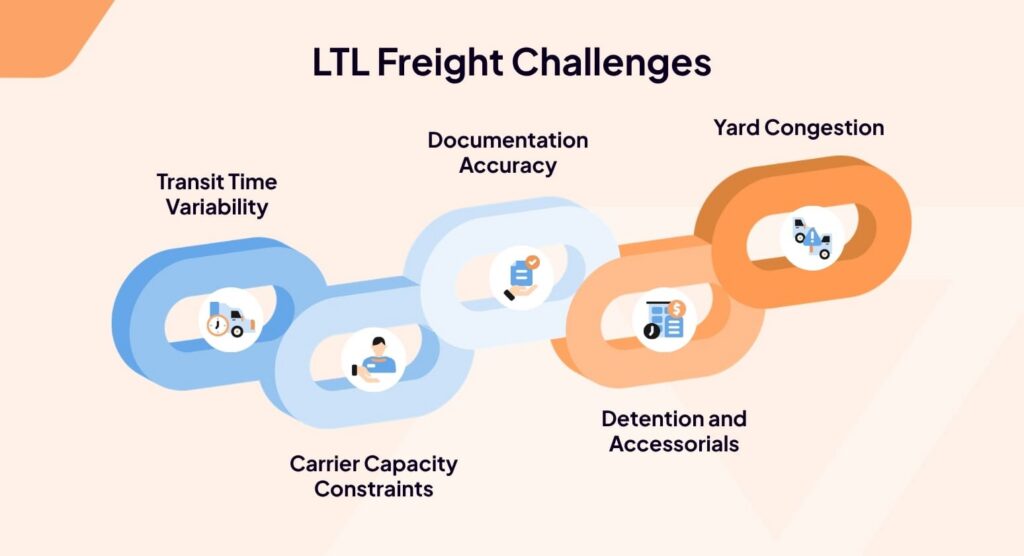
LTL freight creates predictable pain points that compound across your facilities: longer transit times that strain OTIF commitments, capacity constraints that push reliable carriers toward competitors, and documentation gaps that stretch billing cycles while generating disputes your team struggles to resolve.
Longer Transit Times and Their Effect on OTIF Performance
LTL’s hub-and-spoke network creates inherent transit variability through multiple terminal stops and consolidation delays. Your OTIF commitments become harder to protect when shipments face unpredictable dwell times at each terminal.
This variability creates scheduling pressure at your receiving facilities. Challenges increase when drivers arrive outside planned windows, forcing your team to choose between missed appointments or extended detention exposure.
Carrier Capacity Constraints and Shipper-of-Choice Implications
Carrier capacity is a relationship asset. When your facilities create friction — slow turns, missing paperwork, or extended driver wait times — you lose priority access in tight markets.
Carriers earn more profit from shippers who make their operations efficient. Your operation either earns carrier preference or watches capacity flow to competitors. Facilities that delay drivers see reduced service levels and higher rates when freight markets tighten.
Documentation Accuracy, BOL Errors, and Invoice Disputes
Paper BOLs create the structural foundation for reclassification disputes and missing PODs that extend billing cycles from days into weeks.
BOL errors — wrong freight class, missing dimensions, inaccurate commodity descriptions — accumulate into carrier reclassifications that inflate costs over time. You can’t defend disputes effectively without complete documentation.
Electronic BOLs with timestamps, geocoordinate stamps, and AI imaging create a digital audit trail that closes these documentation gaps.
Vector’s eBOL digitizes this process, accurately capturing timestamped proof of delivery and enabling immediate invoice processing. Your team gains the documentation needed to resolve disputes quickly rather than absorbing reclassification costs.
Detention, Accessorials, and Reclassification Charges
Three cost categories consistently erode your LTL freight budgets beyond base rates.
Detention charges accumulate when slow facility turns keep drivers waiting beyond carrier-allowed time windows.
Accessorial fees hit when your shipment requires services not captured at booking—inside delivery, residential stops, or special equipment.
Reclassification penalties are triggered when carrier inspection reveals freight descriptions that don’t match actual commodity, weight, or dimensions, forcing rate adjustments that can double your original quote.
Dwell Time and Yard Congestion at LTL-Heavy Facilities
When yard staff can’t see trailer locations or dock status in real time, your team defaults to manual yard walks and reactive scheduling. Both extend driver wait times and inflate detention exposure.
Digital check-in, dynamic dock assignments, and real-time trailer tracking without needing to add expensive RFID infrastructure give dispatchers the data they need before problems compound.
Facilities are eliminating the “yard as black box” problem — platforms like Vector show accurate trailer locations and live dock status, enabling proactive decisions instead of crisis management.
Your yard staff can assign docks based on actual availability rather than outdated spreadsheets. Dispatchers can flag detention risk hours before it occurs.
The Role of Technology in LTL Freight Optimization
Executive summary: Connected logistics platforms replace paper-based LTL workflows with digital documentation, real-time yard visibility, and TMS integration. Electronic BOLs, digital check-in, and trailer tracking form the core technology stack.
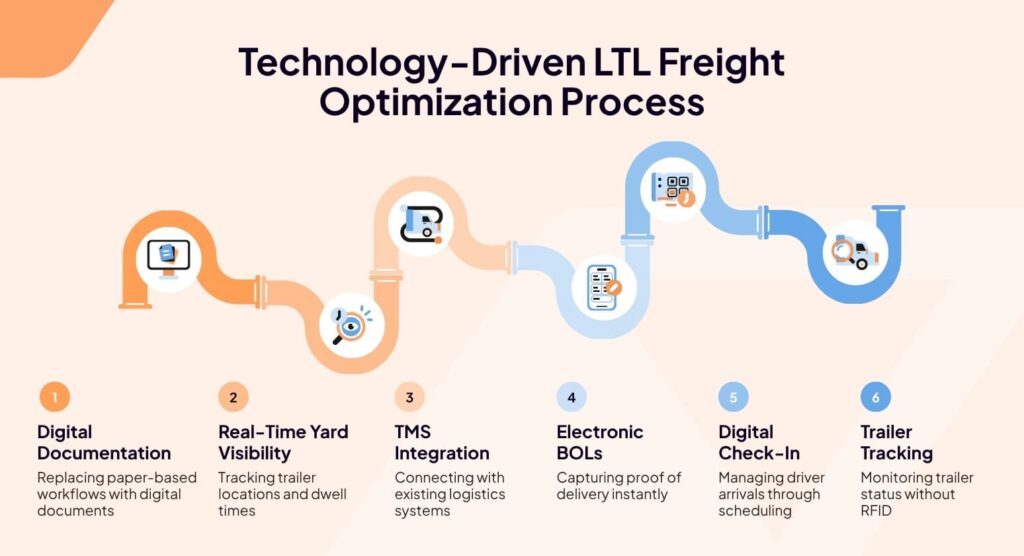
Logistics platforms are transforming how facilities handle LTL freight documentation, yard visibility, and carrier communication.
Digital workflows replace paper-based processes that create billing delays and detention charges. Vector represents this shift toward connected facility platforms that digitize the entire shipment lifecycle.
Electronic BOLs and Instant POD Capture for Faster Invoice Cycles
Waiting days or weeks for POD documentation creates cash flow bottlenecks that compound across multiple shipments. Electronic BOL platforms eliminate these delays by capturing proof of delivery instantly through digital signatures and timestamped verification.
Vector’s eBOL exemplifies this approach with AI imaging, geocoordinate stamps, and offline queuing that functions regardless of connectivity. Your team can trigger invoice submission immediately upon delivery confirmation rather than waiting for paper documents to filter back through carrier networks.
The digital audit trail provides confirmed delivery time and location data that supports dispute resolution when invoice deductions arise. This documentation infrastructure transforms weeks-long billing cycles into same-day processing.
Digital Check-In and Dock Scheduling to Reduce Driver Wait Times
Digital check-in platforms convert chaotic gate arrivals into managed scheduling. Vector’s FastPass® enables SMS pre-check-in and converts guard shacks into welcome centers, eliminating driver wait times.
Facilities that reduce arrival friction earn carrier preference and attract more reliable capacity in tight markets.
Yard Visibility and Trailer Tracking for LTL Inbound and Outbound Flows
Real-time yard visibility gives your team the foundation needed for accurate dock scheduling and detention prevention.
You can see exact trailer locations, current dwell times, and live dock status — enabling decisions like adjusting assignments or flagging detention risk before it compounds.
Vector’s approach tracks trailers without needing to add expensive RFID infrastructure. Customer facilities have reduced physical yard audits from up to four times daily to once daily for exceptions management.
This eliminates manual yard walks that pull your staff away from higher-value work while keeping trailer status current across shifts.
Integrating LTL Workflows With Existing TMS, WMS, and ERP Systems
LTL workflow platforms rarely compete for top-priority budget, making fast deployment and minimal IT involvement critical selection criteria.
Vector connects to SAP, Oracle, Manhattan Associates, and Blue Yonder — no custom development required. Your team can evaluate and implement without disrupting ongoing operations or competing against higher-priority system upgrades for resources.
Vector Closes the Documentation Gap in LTL Freight Management
Vector’s logistics workflow platform digitizes the LTL shipment lifecycle to eliminate documentation backlogs and detention disputes that strain carrier relationships and freeze cash flow.
- eBOL with AI imaging compresses billing cycles from weeks to hours by creating timestamped, geocoordinate-stamped digital audit trails that support instant invoicing
- Digital signatures and electronic documentation reduce invoice deductions by providing legally binding proof that carriers cannot dispute
- FastPass® check-in eliminates driver wait times through SMS-based pre-arrival processing and real-time dock assignments
- YMS trailer tracking provides continuous yard visibility without needing to add expensive RFID infrastructure, showing exact trailer locations and dwell times
- API, EDI, and email integration connects to existing TMS, WMS, and ERP systems without requiring major IT projects
Explore how Vector supports your facility’s LTL operations and carrier relationships.
FAQs
Is FedEx Freight the Same as LTL?
FedEx Freight is one LTL carrier among many — it operates an LTL network but isn’t synonymous with the freight mode itself. Other national and regional carriers like Old Dominion, XPO, and Estes also operate LTL networks.
How Many Pallets Are Considered LTL?
LTL typically applies to shipments that don’t fill a full trailer, often ranging from one pallet to around 10-12 pallets, depending on size and weight. Specific thresholds vary by carrier and lane, so check with your carrier for their guidelines.
Published on April 07, 2022
Last updated on June 15, 2026
Subscribe to stay updated on Vector and logistics trends
" " indicates required fields

Continue reading

Ready to transform your supply chain?
Increase efficiency and productivity. Say goodbye to delays, handwriting errors, and time-intensive manual data entry.