
How AI Supports Your Yard Operations Team Without Replacing It
6 min read
Key takeaways
- AI in yard operations earns its keep through issue detection, flagging exceptions and routine automation. Experienced staff keeps control of exceptions, safety, carrier calls, and the physical work that stays with people.
- Vector customers cut physical validation audits from multiple times daily to once daily, so the yard still gets walked but only on the trailers that need eyes.
- AI Imaging Agents verify document authenticity and detect BOL manipulation before a document reaches billing, catching removed or hand-edited fields and misplaced signatures a dispatcher cannot reliably spot shift after shift.
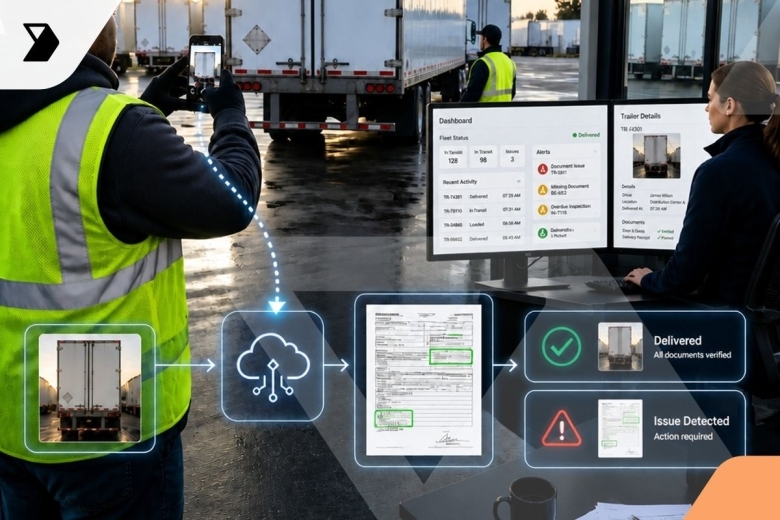
- The automation triggers off physical reality, not a guess, so when a spotter photographs a trailer in its new spot and uploads it, that upload becomes the system update trigger.
Most vendors pitching “AI for the yard” promise to run the whole operation and quietly skip the parts where an algorithm can’t help. AI earns its keep by monitoring dwell and the detention it drives, handling rules-based spotter tasking, and flagging banned drivers and failed credentials at the gate. It also surfaces patterns across sites that no one can spot in raw data.
However, exception handling and safety calls still need staff on the ground, along with the trailer that’s blocked in a lane.
Below, we map exactly where AI helps and where your team stays in control.

Ready to transform your supply chain?
Increase efficiency and productivity. Say goodbye to delays, handwriting errors, and time-intensive manual data entry.
What AI in Yard Operations Means Today
Executive summary: Yard AI functions as decision support that tracks dwell, verifies documents, and flags anomalies, letting teams act on ranked exceptions instead of repeated manual yard walks.
AI in yard operations helps track dwell and detention, verifies documents, and flags anomalies across sites. Yard teams can act on prioritized exceptions instead of walking the yard multiple times a day.
That definition matters because “AI” gets stretched to mean full autonomy. It doesn’t run the yard on its own. It reads the data your operation already generates and tells your team where to look first.
Here’s what that covers in practice:
Imaging That Checks Documents
AI Imaging Agents verify document authenticity and detect POD manipulation, such as fields that have been removed or hand-edited, as well as misplaced signatures. Bills of lading are validated at yard intake, while proofs of delivery are verified upon shipment completion, when signed delivery receipts serve as the POD.
Every document gets compared against a source of truth, and the model returns a confidence score, so your team knows which documents to trust and which to pull.

The system also flags missing or inaccurate data before it reaches billing, the kind of small error that becomes a deduction weeks later. A dispatcher reviewing hundreds of documents a shift cannot reliably catch a doctored timestamp. The model checks every one the same way, every time, without fatigue.
Visibility Without New Hardware
Real-time trailer tracking gives you continuous location data on every trailer, with no RFID tags or costly hardware to buy, mount, or maintain. The location signal comes from the work your team already does.
A driver checks in at the gate, a spotter photographs a trailer in its new spot and uploads it, and each event updates the yard map on its own. There are no tags to lose or replace and no GPS drift to correct.
The only device required is the tablet a spotter already carries in the cab. You get the visibility an RFID rollout promises, without the capital request that stalls in budget review.
Exception Surfacing and Prioritization
The system surfaces exceptions, prioritizes decisions, and automates routine actions, so your team works a ranked list instead of the whole yard. It alerts your team to a damaged trailer that needs pickup or a banned driver arriving at the facility, and it can route an inbound refrigerated trailer to the right door by cargo type.
The point is not the volume of alerts but the order they come in. Instead of walking every lane to find the one problem, your staff opens the shift with the handful of trailers the data says are off, and the routine moves happen on their own.
Data Checks Across Sites
The system catches problems like mismatched trailer numbers or incorrect dock assignments before they turn into operational headaches, matching what the data says against what should be true. It also reads across facilities, so a pattern that hides at one site shows up when you look at the whole network.
Dwell broken down by carrier, by time of day, and by process stage tells you where the delay actually sits, not just that it exists. One yard can feel busy without anyone knowing why. Pulled together across sites, the same data points to the carrier, the shift, or the step that keeps costing you.
None of that removes people from the yard. Instead, it changes what they spend their time on. Rather than walking the yard multiple times a day to confirm where trailers sit, your team reviews the handful of cases the system flags as off.
Where Humans Stay In Control of Yard Operations
Executive summary: AI ranks and flags, but people own the calls that carry risk. Exception handling, safety, carrier and driver relationships, and the physical work of the yard stay with experienced staff.
AI is good at narrowing the list. It’s less good at the judgment that comes after. The moment a decision carries risk, cost, or a relationship, an experienced person should be the one making it.
Here is where that line holds in yard operations:
- Exception Handling: The system flags the trailer that doesn’t match its record. What to do about it is a human call. A mismatched seal, a load that reads heavy, a driver who arrives without an appointment: each one carries context the data doesn’t, and someone on your team has to weigh it and decide.
- Safety-Critical Decisions: Moving a blocked trailer, pulling a spotter off a congested lane, holding a truck when the weather turns. These are calls where being wrong can hurt someone. They belong to the people who can see the yard and read the moment, not to a model working off a data feed.
- Carrier and Driver Relationships: When a carrier disputes detention or a driver has been sitting too long, the fix is a conversation, not a workflow. Your team knows which carriers to protect, which to push, and when a phone call settles something faster than a system can.
- The Physical Work of the Yard: A trailer is a physical object in a physical space. Someone still has to hook it, move it, check the seal, and read the reefer. Software can tell a spotter where to go and what’s next. It can’t back the trailer into the door. The yard runs on people, and it will keep running on people.
The honest framing is that AI is decision support. It reads the data, ranks the work, and hands your team a shorter, smarter list. The experience stays where it belongs, with the staff who run the yard.
How Vector Helps You Run AI-Assisted Yard Operations
Everything above is a division of labor, and a platform earns its place here only if it respects that line rather than trying to erase it. Vector is built around that split. The software does the reading and the ranking. Your team does the deciding.
Here is how the pieces line up in a working yard:
- Documents Get Checked Before They Cost You: Vector’s eBOL records every transaction with AI imaging, electronic signatures, timestamps, and geocoordinate stamps, and AI Imaging Agents verify authenticity and catch a doctored proof of delivery before it reaches billing.
- Trailers Stay Visible Without New Hardware: Real-time trailer tracking provides continuous location on every trailer with no RFID tags or costly hardware, and the yard map updates based on real events.
- The Gate Does the Lookup: Digital check-in captures the driver, carrier, and load, and the system alerts your team to a banned driver or a damaged trailer before the truck is deep in the yard. The guard’s judgment still runs the lane. The software just does the checking.
- Billing Runs Off the Same Capture: Because the record is clean and time-stamped at the source, billing can start the moment delivery is confirmed. That is how Vector customers cut billing cycles from weeks to hours and reduce invoice deductions.
See how Vector runs the yard, from the gate through documents and billing, and how it deploys in weeks for the teams on the floor.
FAQs
Do Drivers Have to Change How They Work to Use an AI-Enabled Yard System?
Not much. Vector accommodates the reality that different stakeholders prefer different interaction modes. Drivers keep their paper documents while the system builds a digital twin through mobile scanning or gate kiosks with OCR. Communication runs over SMS-based messaging that keeps drivers in their trucks for safety, so there’s no app to force on anyone. That familiar experience is what cuts change-management friction on day one.
How Long Does It Take to Get AI Running in Yard Operations?
Fast. Pilot sites can be operational within weeks, with minimal change management required. Vector treats implementation as a collaborative process rather than a hand-off, working as a partner through the rollout. That timeline matters because yard management rarely ranks as a top-10 initiative. You want decision support you can turn on without pulling your team off the floor for a quarter-long project.
What Happens if the Yard Loses Internet Connectivity?
Work keeps moving. Vector’s platform functions offline by queuing digital packages until connectivity returns. Spotters and drivers capture signatures, photos, and timestamps the same way they always do, and the system syncs those records once the connection is back. You keep the full audit trail, and gate and dock workflows don’t stall waiting on a signal.
Do I Need RFID Tags or Barcodes for AI-Based Trailer Tracking?
No. Vector provides real-time trailer tracking that eliminates the need for RFID tags or costly hardware. That means you skip the expense of adding new infrastructure across every gate and dock. Tracking runs on the workflows your drivers and spotters already touch, not on hardware you have to buy, mount, and maintain.
How Does AI Speed Up Billing, Not Just Physical Yard Work?
The same data capture that tracks trailers also feeds your paperwork. AI imaging, electronic signatures, timestamps, and geocoordinate stamps create a complete digital audit trail for every transaction. AI Imaging Agents verify document authenticity and detect POD manipulation before a bad document reaches billing. Vector customers cut billing cycles from weeks to hours. Faster, cleaner documentation also supports better carrier relationships, though your rates still depend on volume, lanes, and payment terms.
Published on August 10, 2026
Last updated on August 10, 2026
Subscribe to stay updated on Vector and logistics trends
" " indicates required fields

Continue reading

Ready to transform your supply chain?
Increase efficiency and productivity. Say goodbye to delays, handwriting errors, and time-intensive manual data entry.