
Why Yard Management Without Hardware Beats RFID Rollout
7 min read
Key takeaways
- Yard management without hardware captures the same location signal RFID promises, but from driver check-ins, spotter photo uploads, and geofenced ETAs rather than tags, readers, or fixed gate sensors.
- A spotter captures and uploads a photo of the trailer in its new slot. Vector digitizes the image and extracts the data to update the position, replacing manual data entry with data capture and removing the duplicate documentation that follows every yard move.
- Digital yard audits let customers reduce physical validation from multiple daily walks to a single daily exception check.
Getting real-time trailer visibility used to mean bolting RFID gantries at the gate, tagging every trailer, and writing a capital request big enough to stall in budget review. Meanwhile, staff walk the yard many times a day to find trailers by hand, and detention charges pile up across hundreds of loads a month.
There’s another way to capture the same location data. Driver check-ins, spotter photo uploads, and geofenced ETAs supply what an RFID reader would otherwise record, without the cost of adding new RFID infrastructure.
This guide covers how that approach works, where it cuts dwell and detention, and how it compares to a hardware-heavy rollout.

Ready to transform your supply chain?
Increase efficiency and productivity. Say goodbye to delays, handwriting errors, and time-intensive manual data entry.
How RFID-Free Yard Management and Trailer Visibility Works
Executive summary: Spotter photos, gate check-ins, and geofenced ETAs replace RFID tags and fixed readers to automatically log every trailer arrival, slot move, and departure.
Yard management without hardware captures real-time trailer location and status data via driver check-ins, spotter photo capture, and geofenced ETAs, providing continuous visibility without RFID tags, barcode readers, or fixed sensors.
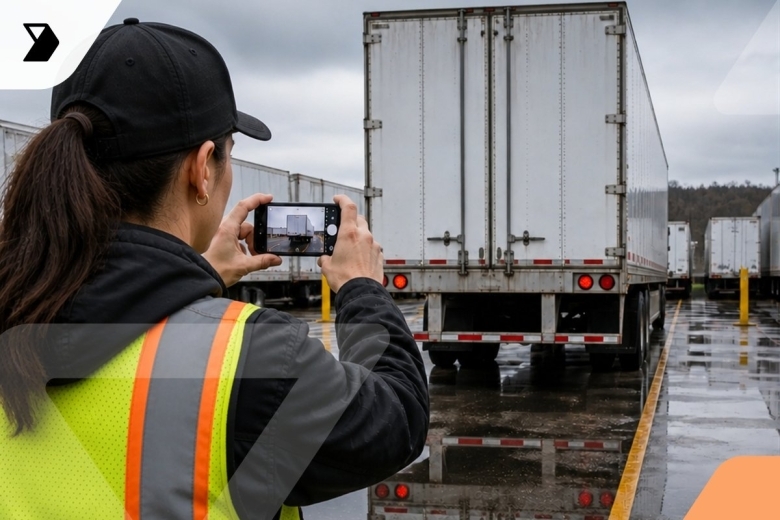
The signal is the same one RFID promises. A trailer arrives, moves to a slot, gets pulled to a dock, then leaves. What changes is how you capture each of those events. Instead of a fixed reader logging a move, a spotter photographs the trailer in its new spot, and the software reads the location from that image.
The photo is not the record on its own. When the spotter uploads it, Vector digitizes the image, extracts the data and updates the yard record based on what it captured. That shifts the work from manual data entry to data capture and removes the duplicate documentation each move used to create.

Geofenced Check-In and Real-Time ETA Tracking at the Gate
The first location signal lands before the truck reaches your gate. On Vector, the platform runs geofenced check-ins with real-time ETA tracking, so you know a truck is coming and roughly when it arrives. The driver checks in via SMS, an app, or a kiosk. Nobody walks out to the lot to log the arrival by hand.
That arrival data drives dock assignments while the truck is still inbound. The system already knows which door is open and sends the driver straight there, which cuts the wait time that would otherwise result in OTIF penalties.
Drivers and your office communicate via SMS, so the driver stays in the cab for safety, and you lose the back-and-forth at the guard shack. You get the gate timestamp and the dock assignment in one motion, and the driver spends less time parked and waiting.
Spotter Photo Uploads That Capture Position Data
Once a trailer enters the yard, the spotter gives you the next-position signal. On Vector, when a spotter takes a photo of a trailer at its new location and uploads it, the platform digitizes the image. It extracts the data, updating the record from that capture instead of a keyed-in log entry.
The spotter parks the trailer and takes a picture. Vector reads the trailer and its location out of that image and posts the new position, so there is no clipboard and no re-keying the move into a separate yard log.
The captured data, not the raw image, becomes the position update. It replaces the tag scan and runs on the tablet or phone the spotter already carries in the cab.
Rules-Based Task Assignments Pushed to Yard Staff and Spotters
Location data only helps if the right move happens next. That’s the part most yard teams get wrong. They install visibility, then leave the dispatch decision to whoever’s on the radio. Vector closes that loop with rule-based automated task assignments for spotters and yard staff, delivered via tablets or mobile devices in the cab.
When an inbound trailer needs to move to a dock, the system assigns the job and sends it to the closest spotter.
Those assignments run on live yard data. Vector pairs them with automated dock assignments and visibility into parking status, so the system knows which slots are full and which doors are ready. Yard truck activity then flows into your WMS, with Vector coordinating between dispatchers and warehouse teams by receiving inbound shipment data and dock status.
This is where dwell drops. Your staff stops guessing which trailer to grab next. The task comes to them, already prioritized, and nobody wastes a spotter run on a door that isn’t open yet.
Digital Yard Audits That Reduce Physical Validation Rounds
The fourth signal keeps the yard map accurate without constant walking. Vector runs digital yard audits, and the payoff shows up in fewer trips outside. Customers have cut physical validation audits from multiple times daily to once daily for exception management.
Instead of walking the yard multiple times a day to count trailers, your team conducts a single audit and handles only trailers that don’t match the record. The three earlier signals keep the trailer count up to date between rounds, so the physical walk becomes a spot check rather than a full recount.
With this shift, you move your teams from operators to analysts. Your yard staff spends their time on the exceptions, not on reconfirming the trailers that already line up.
Put the four signals together, and you get real-time yard orchestration with complete visibility into every trailer, without adding expensive RFID infrastructure. The gate check-in indicates that a trailer has arrived. The data Vector extracts from the spotter’s photo tells you where it moved. The task rules tell staff what to do with it. The daily audit confirms the whole map holds.
Getting Started With RFID-Free Yard Visibility
Executive summary: A useful pilot requires first quantifying quarterly detention charges and yard-walking labor hours to establish a measurable before-and-after baseline.
A pilot only tells you something if you know where you started. Pull the last quarter of detention invoices and demurrage charges across your facilities, then add up what your team spends walking the yard.
If staff run physical validation audits three or four times a day, that’s labor you can put a number on. Those two figures, detention spend and audit hours, become the baseline you measure against.
What to Measure Before a Pilot (Current Dwell and Detention Spend)
Start with the money leaking out. Pull your detention and demurrage charges by facility over the last 60 to 90 days, then log your average trailer turn times and how often drivers sit at the gate waiting.
Vector’s yard management system reduces physical dwell time and detention fees caused by facility delays, so these are the numbers you’ll see move first. Get them on paper before you touch anything else.
For instance, if one site is eating 60% of your detention spend and another is clean, you want to know that going in, because the pilot should start where the pain is.
What Facilities Need (and Don’t Need) to Start
To run this approach, your facility needs three things:
- Internet access at the gate, plus one data handoff point into your WMS or TMS. That handoff is what lets yard truck activity flow into the WMS and lets the YMS pull inbound shipment data and dock status back out.
- Mobile devices in cabs. Your spotters and yard staff already carry tablets and phones, which serve as the interface for rules-based automated task assignments right from the cab.
- A driver check-in method through SMS, app, or kiosk. SMS-based messaging between the driver and office keeps drivers in their trucks, which is a safer setup in a busy yard.
What you don’t buy is RFID readers, printed barcodes, or wired sensors. On Vector, the platform operates without requiring RFID tags or costly hardware, and it doesn’t advocate for barcode or RFID deployment strategies.
The location data comes from geofenced check-ins and spotter photos instead. When a spotter uploads a picture of a trailer in its new spot, Vector digitizes it and extracts the location, updating the record from that captured data. That replaces manual data entry with data capture, with no duplicate paperwork.
Turn Your Yard Into a Real-Time Map Without RFIDs
Chasing trailers on foot, running physical yard checks multiple times a day, and guessing where inventory sits are the quiet costs that inflate dwell and detention.
Vector’s YMS gives continuous trailer visibility without the RFID tags or costly hardware that traditionally stand between a yard and accurate location data, so the guesswork stops and the clock starts working in your favor:
- RFID-Free Tracking: Real-time trailer tracking delivers continuous visibility into trailer locations while eliminating the need for RFID tags or costly infrastructure.
- Photo-Captured Updates: When a spotter uploads a photo of a trailer in its new location, Vector digitizes the image and extracts the data to update the record, replacing manual data entry with data capture and removing duplicate documentation.
- Rules-Based Task Assignment: Automated task assignments route spotters and yard staff through in-cab tablets and mobile devices without leaving their trucks.
- Digital Yard Audits: Continuous validation has enabled customers to transition from multiple daily physical audits to a single daily audit for exception management, freeing teams to focus on real issues.
- Connected WMS Coordination: Yard truck activity flows into WMS systems, coordinating dispatchers and warehouse teams using inbound shipment data and live dock status.
See what RFID-free yard visibility looks like with Vector and reduce your dwell and detention without a hardware project.
FAQs:
Does RFID-free yard management work for facilities that already have some RFID infrastructure?
Yes. You keep what you have. Vector’s solution “works without requiring RFID tags or costly hardware implementations, and the platform does not advocate for barcode or RFID deployment strategies.” If a site already runs RFID at a few gates, that stays. The check-in and spotter-capture workflows cover the slots hardware doesn’t, so you get consistent location data across every spot without extending readers to the whole yard.
Is this approach suitable for facilities with high trailer volumes and complex yard operations?
It’s built for that load. High-volume yards are where blind spots hurt most, and where staff wastes the most time walking to confirm what’s parked where. Vector provides “real-time yard orchestration with complete visibility into every trailer,” plus trailer pool monitoring of pre-positioned trailers with real-time availability analytics. Digital yard audits let busy sites drop from multiple daily physical validations to a single daily validation for exception management.
Published on August 03, 2026
Last updated on August 03, 2026
Subscribe to stay updated on Vector and logistics trends
" " indicates required fields

Continue reading

Ready to transform your supply chain?
Increase efficiency and productivity. Say goodbye to delays, handwriting errors, and time-intensive manual data entry.